Sunday, December 13, 2015

Great pet gifts for this holiday season

One of the highlights of Christmases past has been watching my pets open their gifts. My favorite memory is of my gentle dog, Chris, frantically tearing at the wrapping paper while making excited wuffing noises. Upon opening the package and finding his favorite fleece Chewman toy, he trotted merrily around the house, continuously squeaking it. The grand finale was when he removed the noise maker with surgical precision. A short-lived plaything, but his joy made it worth every penny.

Not only do dogs and cats enjoy opening presents, but their people do, too. And dog and cat owners appreciate pet-related gifts. To that end, I’ve been keeping a list of noteworthy goods that are veterinarian approved ─ by me, of course! 

Here are my top picks for Christmas, 2015: 


I love these elegant 12-ounce microwave- and dishwasher-safe mugs. They’re chic and come individually packaged in brightly colored artsy boxes. 


Kyjen Outward Hound Port-a-Bowl  $4 - $17

A must for the active outdoor dog! It dries quickly and collapses to fit in  your packpack, pocket, or purse, and it can be used for food or water on the go. Every pooch can use a refreshing drink of water during his walk on a hot day. 


Cat climber (Door Hanger)  $99.95


I wish that I had thought of this – brilliant! This cat tree fits a standard 80-inch door, but its spring-loaded bracket system allows it to adjust to similar-size doors. And the post is made of sisal for scratching.  Move it from door to door to give your cats a new view. 


Show off your pet every time you pick up your cell phone: Have his or her picture incorporated into a custom Renaissance portrait for your iPhone or Samsung Galaxy phone case. Choose among characters such as a king, queen, guard, beggar, saint, jester, maid, or general ─ from humble quadruped to King Henry VIII in the blink of an eye!

You’ve just spent megabucks redecorating your kitchen. Do you really want to plunk that nasty old chipped dog bowl down on the floor?  Mon Dieu, non! Besides, veterinarians recommend raised feeders for your pet’s comfort. From the metal grillwork base in an aged copper finish to the natural slate top, this feeder combines elegance and rustic charm. Sure, it’s ridiculously pricey; but your chien spécial deserves to eat in style!


Sleepypod mobile pet bed $139.99-$179.99


It’s a bed! It’s a carrier! It’s a safe car seat! It’s all three products in one. Turn it from a bed into a carrier by zipping on the mesh dome. A seat belt can be fastened through the handle for travel. I especially love this for cats, who will enjoy traveling in the comfort and familiarity of their own bed. What a great way to reduce stress on those visits to the vet! 


Drinkwell Ceramic Pagoda Fountain for Pets $79.95, in taupe, blue, red, or white

Veterinarians recommend fountains to encourage water drinking, especially for senior cats and dogs. My objection to the ones that I’ve owned is that they get slimy and are hard to clean. And they’re ugly!  Drinkwell has come out with a fountain with simple, elegant lines. Not only is it attractive, it’s made of easy-to-clean ceramic, and it’s dishwasher safe. It has an upper and lower dish to accommodate both small and medium-sized pets. The carbon water filter helps keep the water fresh. 


Wheel House Socks $10.95 


These comfy socks come in multiple sizes and colors. With dozens of breeds from which to choose, they're the perfect stocking stuffer for the dog lover in your life. 


Zogoflex  $7.95 - $10.95


I researched the best chew toys for dogs in a previous post, and these came out on top. They won’t fracture teeth, and they’re environmentally friendly:  When you send your worn-out Zogoflex toys back to the company, West Paw recycles them into new ones. They come in a variety of colors and shapes, so there’s a good chance you’ll find one that your buddy approves of.


Interactive feeding toys help slow hasty eaters, and this one makes meals more interesting. Your dog will learn to turn the revolving sections to reveal his vittles. The Tornado allows you to gradually increase the level of difficulty as his skill improves. Dogs like to have a job, and this feeder gives them a sense of accomplishment.


Rope Slip Lead, 4 feet and 6 feet  $7.99

A humble gift, yes, but one much favored by veterinarians, shelters, and trainers. We use these at Vernon Hills Animal Hospital. When our clients feel how soft and well made these rope leads are, they invariably ask where we got them and buy a couple for themselves.


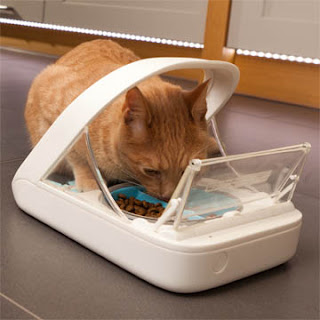
Do you have a feline food bully at home who nudges your other cats out of the way and eats too much food? I do, so when I saw this microchip feeder I had to have it!  It works with your cat’s existing microchip (or we can insert one for you) or with the included tag. When your pet approaches the feeder, a covering slides up and allows her to eat. When she’s finished, it quietly closes. The two bowls, which are suitable for both dry and wet food, seal tightly to ensure freshness. I love that it runs on batteries, so there are no cords.

If you think $149 is pricey, consider the financial implications of diabetes and other obesity-related diseases, which can cost hundreds of dollars in vet bills every year. Now our clients whose cats are on weight-loss and prescription diets won’t be able to steal other cat’s food and overeat.  Awesome!

Pet Tree Houses   $199-$1999

Ridiculously expensive, but so cool I just had to include these. They’re made from real trees embellished with silk foliage to give your feline friend a lifelike experience. The trunk can be used as a scratching post. But there’s no need to spend megabucks to own one. For someone good at woodworking, I think this would be a fun, reasonably priced do-it-yourself project.


Happy shopping, and happy holidays to you and your family members, including the furry ones!


Tuesday, December 1, 2015

The cyberbullies have their claws out

Every year the American Veterinary Medical Foundation, the charitable arm of the AVMA, hosts the America’s Favorite Veterinarian contest. Its objective is to “honor and recognize those entrusted to preserve and protect the health and well-being of pets, as well as to celebrate the special relationship pet owners share with their veterinarians.” Seems like a laudable and harmless event, right?


A group of animal rights activists opposed to declawing cats disagreed, and it launched vicious cyberattacks against most of this year’s 20 finalists. Their actions brought the contest to a halt before a winner could be declared.


The activists phoned the animal hospitals where the finalists worked and, posing as potential clients, asked about declawing. If those hospitals performed declaws, the activists subjected them to fraudulent negative advertisements on Facebook, damaging negative online reviews, and threatening phone calls. One contestant was called “a whore, a butcher, a mutilator, a hack, an animal hater, a disgrace to the profession.”

Most of the practices contacted did offer the surgery as a last resort if their clients had tried everything else to prevent destructive clawing behavior, or if being scratched presented a health risk for the cat owner. That is the stand we also take. We discuss alternatives with our clients. If they decide they must have their cat declawed, and if it’s an indoor cat, we’ll perform the procedure if the case fulfills the criteria we have established in our practice.

My experience has been that cat owners who make the decision to declaw don’t take it lightly. They’re concerned about whether their kitty will be in pain after the surgery, and about how he’ll function without front claws. Because we use both general and local anesthesia, a CO2 laser, pre- and post-op pain medications, and take-home analgesics, our patients experience very little pain and discomfort. They also function very well with no front claws. I can’t recall any long-term complications in cats we’ve declawed, and our clients are pleased with the results.

Many of our clients disagree with declawing and choose not to remove their cat’s claws. I support that decision; I prefer not to declaw. But I always urge cat owners to think ahead:  What if they buy an expensive sofa, for example, and their cat destroys it? Will they accept that willingly, or will they then decide to declaw? Young cats recover quickly from the surgery, but it can be much harder, both physically and mentally, for older cats. Because of that, we prefer not to declaw adult cats. So it’s imperative that owners carefully consider the pros and cons of living with a fully armed cat before making a decision. 

I understand the passion of animal rights activists. In fact, I’ve eaten a completely plant-based diet for almost five years, not only for health reasons but also because I feel that big agriculture is inhumane to our animal friends.  It may seem like my views – about preventing animal cruelty by not eating animal products, but allowing cat declaws – are at odds with each other. But exceptions are the rule. Some populations need to eat animal products in order to survive; I fully accept that.  And sometimes we have to declaw a cat to allow him to share a loving home with humans.

Pet owners have to make many life-changing choices for their pets, and most do so with good intentions. We can’t allow bullies to interfere with decisions that should be made between a client and a doctor. 


 Great scratching post!

Tuesday, November 10, 2015

Feline frenemies: Redirected aggression

I awoke at midnight one night last week to the sound of loud, banshee-like wails coming from the other end of the house. I immediately knew what was up: My cats were at war with each other. They’re Cornish Rexes with the same parents, but from different litters, and they’re best buds. They’ve had their share of skirmishes, but this was unlike anything I’d ever heard.


I cautiously entered the room where they sleep at night and found both cats circling the room in a crouched position, staring and hissing at each other. Their ears were flattened and their tails were lashing. After I took my younger cat out of the room, my older cat, Hogan, body-slammed the sliding-glass door leading outside, as if to attack an enemy in the dark beyond. That confirmed my suspicion: It was a case of redirected aggression.

This puzzling behavior results when a cat is highly aroused in a negative way, which triggers his instinct to attack. The classic example we veterinarians use is this: A cat looks through the window and sees another cat outdoors. For most cats, the invasion is a declaration of territorial war. The indoor cat becomes aggressive and fearful but can’t get to the outdoor enemy. It’s highly frustrating. Another pet or a person comes near the distressed cat, and the cat attacks the unsuspecting victim – even if there is no history of animosity between the two. That scenario is undoubtedly what prompted the battle between my two little guys.

A curious thing about redirected aggression is that the aggressor can develop learned associations that can cause him to react even when the initial inciting stimulus — in this case, the outside cat — is no longer around. One of my clients told me a story about her two cats, who were snoozing on the sofa one day while she was watching Nat Geo. There was a loud, violent fight between two wild animals on TV, which awoke one of the cats and provoked it to attack the other. From then on, that cat reacted adversely to loud television noises, and the owner had to keep him away from her TV when it was turned on. In that case, the origin of the cat’s reaction was obvious, but most of the time, the initial trigger eludes us.

Knowing how to safely manage a highly agitated cat in attack mode is important.

The first thing to do is to separate the two combatants. I threw two thick towels over my younger cat, picked him up, and locked him in a spare room, but I know how to do that quickly and safely. Some cat owners would be wise to stand well away from the aroused felines and simply shut one out of the room when it runs.

Never try to pick up or separate fighting cats with your bare hands. Even breaking up the melee with a glass of water or a broom could provoke an attack on you, so be cautious. Fatalities rarely occur between warring cats, but they are well-armed, and wounds from their claws and teeth are not trivial to either people or pets.1 A cat exhibiting redirected aggression is a dangerous animal.


After you separate them, place one in a “decompression room,” and continue to keep them apart. You can alternate which cat is confined so they don’t feel as though they’re being punished. Hogan, my aggressor cat, stood at the door to the room where I was housing my other cat, yowled, and attacked the door. I then separated them by two doors. After 24 hours I separated them by one door. By the end of day two, Hogan was pawing at the door and meowing for his friend, Cam. I opened the door, and they proceeded to groom each other and cuddle up as though nothing had happened.

Use your own cat’s cues to decide when it’s safe to put them back together. They should remain calm when they smell each other through the door. A good step after the separate confinement is putting one or both in crates for reintroduction. 2 

How can you prevent this nerve-wracking behavior? Identifying the trigger causing arousal and then removing the cat’s access to the stimulus would be ideal.  Take Hogan, for example. His trigger is outdoors, so I’d need to cover the windows so he can’t see any outdoor cats or other animals. That would mean covering nine sliding-glass doors and at least as many windows. Not! And unless it’s only a couple of windows, I don’t expect my clients to do that, either. But occasionally a specific trigger, such as the above-mentioned TV noise, can be avoided.

An observant owner will learn to recognize the signs of an impending conflict and will separate their cats before violence erupts. The owner’s response to a cat’s aggression is very important. Reactions such as yelling, throwing objects, or hitting the cat might redirect his aggression to you from that point on.

If the behavior becomes chronic or dangerous, or if a person is the victim even once, I refer the case to a veterinary behaviorist. They can teach the owner how to desensitize and counter-condition the cats, or at least teach how to recognize the signs of arousal in time to take preventive measures and thwart a battle.

Anti-anxiety drugs, such as Prozac, are a bit controversial for this problem. Behavioral experts aren’t really sure how much help they provide. Besides, sometimes the incidents of redirected aggression can occur years apart. Why subject your cat (and yourself!) to daily pilling when it might not be beneficial, or for a behavior that happens only twice a year? That being said, I’ll recommend one of the calming drugs if the household cats are continually brawling.  I’ve seen plenty of cases in which a client’s cats become permanent enemies and can’t live together, so I figure there’s nothing to lose by trying medication.

After what I experienced, I realize that the key is to be prepared. I now have a litter box and automatic waterer tucked away in my guest room, which came in handy the other day when another incident appeared imminent. Reacting swiftly and safely by separating them will give you the best chance of a speedy resolution.  

Tuesday, October 27, 2015

The trouble with tidbits


Your dog sits near the table and with rapt attention watches every bite you eat. Or perhaps your cat repeatedly head-butts your legs, demanding snacks.  So you give your pooch your leftover toast or your uneaten chicken skin.  You let your kitty slurp up the remaining milk in your cereal bowl.


We love our pets and love to spoil them, so we’re probably all occasionally guilty of that behavior. Besides, it’s only a little tidbit; what harm can it do? 

Treats add unnecessary calories, which lead to unwanted pounds. And those lead to lethargy, inactivity, wear and tear to joints, diseases such as diabetes, and a host of other problems. Another issue is nutrient balance. If your pet’s food is AAFCO1 approved, that means it’s complete and balanced. When you add extra nutrients in the form of snacks, you can throw that carefully concocted nutrient profile out of whack.

Giving snacks is important to many pet owners. I don’t object to my clients feeding up to 10% of their pets’ calories in the form of treats. Once you figure out how many calories you’re feeding your pet, you’ll be able to figure out how many calories that 10% is. But good luck finding the calorie information on the bag of food! You’ll need to do a little research. Go to the company’s website, or call the 800 number on the bag. 

It turns out that the 10% in question translates to a paltry amount of extra morsels. Until I was enlightened by the “doughnut conversion scale,” I had no idea how quickly the calories add up.

What exactly is the doughnut conversion scale? It’s a chart put together by Royal Canin showing the conversion of dog and cat treats to the comparable number of doughnuts for humans.


You gave Fido that slice of toast? Two doughnuts. If he eats a dried pig ear, it’s proportional to your eating three doughnuts. The biggest shock for me was a large knotted rawhide bone: 10 doughnuts!

Cats don’t fare any better. Ten tiny commercial treats equal one doughnut. How much weight would you gain if you ate eight doughnuts a day? Feed your cat one ounce of cheese daily and see what happens to his waistline; that’s the feline equivalent of eight doughnuts!

Pick treats that are nutritious, such as good-quality commercial treats, homemade biscuits, apple slices, string beans, carrots, squash, broccoli or other veggies. Figure out how many of those treats equal 10% of your pet’s daily caloric intake (again, you might need to go to the Internet for calorie information), and set them aside in a bowl every day. That’s it; he can’t have any more, no matter how much those soulful eyes implore you.

If you feel yourself giving in, remember that the enjoyment your dog or cat receives from treats isn’t related to the quantity. The value of feeding tidbits is derived from his interaction with you, and the predictability of the routine. Pets thrive on consistency, so having a set routine2 for giving snacks is a worthy goal.

Feeding and giving treats is an important aspect of the human-animal bond, so enjoy doing it; but pay attention to those doughnuts!


1 Check the small print on the pet food bag. It will say something like “X Brand is formulated to meet the nutritional levels established by the AAFCO (Association of American Feed Control Officials) Dog/Cat Food Nutrient Profiles for maintenance”.

2 Don’t give your dog treats every time he comes in from being outdoors. In my experience, unless you offer very low-calorie snacks, like carrot coins, that is the fastest route to obesity.


Monday, October 12, 2015

What the death of a pet can teach us

Not long ago I was browsing in a store when I heard someone say, “Dr. Molly!”  It was a client whose cat had recently been euthanized, and she told me that she was still heartbroken.  She lives alone, and that kitty had been her constant companion. She then went on to tell me that she would never get another cat again. Losing a pet was too painful.

Folks have lots of good reasons for not replacing their lost pals:  Long hours at work, or otherwise being too busy, can preclude having a dog. Some people want to start traveling and don’t want to have to board or find a caretaker for their pet. Economics and allergies are other good excuses to avoid pet ownership.  But not getting another companion for fear of the inevitable loss is a reason that deserves further consideration. 

About seven years ago I was diagnosed with a chronic disease, and that sent me on a quest to make sense of it all. My research led me to read Victor Frankl’s famous book “Man’s Search for Meaning.” Frankl was a Jewish psychiatrist who was sent to four different concentration camps during World War II. His suffering there was unimaginable. The odds of his survival in the camps were one in 28, but survive he did. His profound book isn’t about just his torment at the camps, but also his insight as to what makes life meaningful. 

I recently reread his book and realized how well it related to my observations as a veterinarian.

Frankl said that we can discover meaning in life in three ways:
  1. By creating a work or doing a deed.
  2. By experiencing something or encountering someone.
  3. By the attitude we take toward unavoidable suffering.
The first two ways, finding meaning in achievement or accomplishment and experiencing something, are easy to understand in the context of pet ownership. By giving a pet a good life, not only are we doing a good deed, but we are also creating the experiences of mutual joy, love, and affection. Frankl contends that experiencing can be as valuable as achieving. That is therapeutic, because we live in a world that emphasizes achievement in the external world at the expense of one’s internal experience. 

The third way is by finding meaning in suffering. Frankl suggested that we can find meaning in life even when confronted with a hopeless situation. It challenges us to change ourselves. “In some ways,” he wrote, “suffering ceases to be suffering at the moment it finds a meaning.” 

The suffering after the death of a beloved pet caused my client to reject the thought of getting another cat. According to Victor Frankl, we would need to find meaning from such an event in order to transcend our anguish. What could possibly be meaningful about losing a beloved companion?

 Losing your pal opens up the opportunity to provide another pet with a happy life. That is especially important for an animal that is confined to a crowded shelter and at risk of euthanasia or that is otherwise homeless. Immersing yourself in sorrow in the long term will preclude your giving love to another dog, cat, or other pet, and it isn’t a righteous tribute to the friend you lost.

Victor Frankl contended that we may find meaning in life when facing a situation, such as death, that cannot be changed. He believed that when we suffer the death of a loved one, we “bear witness to the uniquely human potential at its best, which is to transform a personal tragedy into a triumph, to turn one’s predicament into a human achievement.”  He felt that we should suffer bravely, and he considered that to be ennobling.  Being imprisoned for four years allowed him that unique perspective.

Through suffering the loss of a pet, we survive and learn to cope. If you could see that as an ennobling achievement, as Victor Frankl did, it would allow you to move on. Fear of loss would not deprive you of what could be many more years of giving and receiving the love of a pet. And that will add to the richness and meaning of your life. 


Monday, September 28, 2015

They ate WHAT?

A Doberman pinscher named Zeus will no longer be fetching golf balls that his people have been chipping in the back yard, because 26 of them ended up in his stomach!  Zeus’s x-ray won first place in the annual “They ate WHAT?” contest featured in Veterinary Practice News magazine. Second and third place went to – surprise! – Labrador puppies.


The second-place winner presented with his head stretched out and was retching. When Dr. Mike Jones of Tulsa, Okla., x-rayed him, his response was “Holy cow!” The pup had swallowed the end of a fishing pole. The little guy was sedated, and the veterinarian was able to pull the object out without invasive surgery by grasping it with forceps. 


The list of retrieved objects in this year’s contest was eclectic and included a door hinge, 18 buttons plus a woman’s belt, a spoon, a spray bottle of cologne, 2.6 pounds of stones, and an entire Kong. And this:


Barney?

Dogs aren’t the only critters to ingest odd things.  An honorable mention went to a cat that ate more than 30 hair ties and other string-like items. Another kitty ate 22 coins. A scribbled angelfish had surgery to remove a metal object and a rock. And there was the tragic case of a python that presented with a large swelling. The snake had gotten loose the week before. X-rays revealed a fancy jeweled collar – along with some bones. The python had eaten the neighbors’ Siamese cat.

If you think these types of cases are rare, think again. The sponsor of the contest, Trupanion Pet Insurance, says that foreign body ingestion is the second most common claim it receives for dogs, and the third most common for cats.

I can understand why a dishcloth soaked in food might be tempting, but what possesses a pet to eat 43½ socks (last year’s third-place winner) or this?


It has always fascinated veterinarians that pets willingly gobble up such bizarre things. There are reasonable explanations for some of this behavior. 

Just as a small child may put anything he can find in his mouth, so do puppies and kittens; it’s how they explore their environment. Fortunately, most of them outgrow that tendency. Some pets mistake something that tastes like food (such as the above-mentioned dishcloth) for something edible, so they devour the succulent tidbit. And if you’ve ever chewed a piece of gum and swallowed it reflexively, you can understand why a dog or cat, tearing apart a toy or other object, might swallow chunks of it by mistake. Boredom can also drive a pet to eat strange stuff.  And eating the inedible is just plain fun for some pets!

There are medical and behavioral causes of this behavior, too. “Pica” is the medical term that refers to a craving for, and purposeful consumption of, a non-food item. A number of conditions, such as digestive or metabolic disorders, parasites, illness, and nutritional deficiency, can cause pica. Some pets have pica due to a compulsive disorder. I’ve had patients that are obsessive about seeking and eating strange things, some of which are very specific. One of my dog patients wolfed down stones from the driveway, although he never ate anything else but his food. It was easy to solve that problem by not allowing the dog access to the stones. But veterinary intervention is necessary in many of these cases. 

Here’s how you can decrease the chance that your pet will eat non-food items:

  • Monitor puppies and kittens closely. Do the same for offending older pets.
  • Keep tempting objects out of reach or behind closed doors.
  • If your dog eats junk in your yard, you’ll need to keep him on a leash so you can direct him away from non-comestibles like rocks, leaves, and sticks.
  • Keep pets busy with plenty of physical exercise, such as chasing a ball, daily walks, and romps in the dog park. Play with your cat daily.
  • Provide mental stimulation by playing games.
  • Safe chew toys will help satisfy his need to munch.
  • Teach him the “leave it!” command, so he’ll drop whatever he has in his mouth.
  • A hard-core junk eater will have to be trained to accept a basket muzzle when he goes outdoors.
  • Enlist the guidance of a certified applied animal behaviorist for your dog with compulsive pica behavior. 


If, despite your best efforts, your critter ingests a non-food item, don’t feel like a bad pet owner. Some behavior defies explanation, and some pets are connoisseurs of the inedible. Call us immediately if that happens; sometimes we can induce vomiting and prevent a very expensive belly ache!


Sunday, September 13, 2015

A breath-taking experience: Monitoring your dog’s heart

Whoosh! Whoosh! Whoosh! That was Sadie’s ailing heart, heard via my stethoscope. Not only did the Chihuahua’s ticker sound like a loud washing machine, but I also felt a palpable thrill. Not the kind of thrill you get from winning the Mega Millions lottery: This “thrill” refers to the vibration one can feel on a dog’s chest, caused by a leaky cardiac valve. It means the hound’s heart isn’t healthy.


Heart murmurs (that whooshing sound I heard) are relatively common among our canine patients.  Heart problems usually result from degenerative changes, especially chronic degenerative valve disease (DVD), or endocardiosis.1 Small-to-medium- size older dogs are most affected. I won’t discuss the heart problem we see in (mostly) large breeds, called cardiomyopathy. It isn’t common in our practice, and it usually can’t be diagnosed until clinical signs develop, by which time the prognosis is poor.   

If we examine your dog and mention that we hear a murmur, it’s important that you understand what that means. This diagram will help. It depicts a lengthwise slice through the heart.

#1 points to the left heart valve (mitral valve), which is between the top chamber of the heart (the atrium, #2) and the lower heart chamber (the ventricle, #3). If this valve degenerates, it gets thick and won’t close properly. That allows blood to leak backward into the atrium, and that causes the murmur we hear. Over time, the atrium becomes enlarged due to too much blood volume, and the ventricle wall becomes thickened (#3A) and eventually fails. Fluids leaks into the lungs. Now the dog has congestive heart failure. 

It’s useful to break heart disease and treatment into four stages, A through D: 

     The dog doesn’t have a murmur but is at increased risk of developing heart problems. An example is a Cavalier King Charles spaniel, a breed with a high rate of heart disease, whose sire or dam has endocardiosis. We will carefully listen to his heart at his wellness visits. No treatment is needed in Stage A.

      A murmur is heard, but there are no outward signs of heart disease. There are two sub-stages:
Stage B1:  The heart isn’t enlarged on an x-ray. The intensity of a murmur doesn’t always correlate to the severity of heart disease, and that’s why getting baseline x-rays in Stage B is a good idea. No treatment is needed, but it doesn’t hurt to retake chest x-rays yearly. We also recommend monthly monitoring of Sleeping Respiratory Rate (SRR).
Stage B2:  The heart is getting big. Treatment usually isn’t needed in this stage, either, but we step up the monitoring. Check your dog’s SRR weekly, and repeat the chest x-rays every six months. You’ll also need to check for changes that could indicate heart failure, such as restlessness, coughing, lack of energy, exercise intolerance, or loss of appetite.

      Treatment is needed because signs of heart failure are seen.  Although there is no cure for the common causes of heart failure in dogs, veterinarians can prescribe medications that can greatly improve and extend your dog’s life. In severe cases, a trip to the cardiologist is warranted. 


    The congestive heart failure is getting hard to manage. 

How about preventing DVD in your dog in the first place? Cavalier breeders have guidelines to selectively breed dogs that don’t have heart disease. Because endocardiosis is highly heritable in Cavaliers, this program has been helpful in decreasing the incidence.  But many other breeds are also prone to chronic valve disease. According to the American College of Veterinary Internal Medicine’s consensus statement, CVD affects 85% of all dogs that age 13 and older. Fortunately, most of them develop mild disease that progresses very slowly, doesn’t cause heart enlargement, and never causes heart failure. Although theories abound, the cause of the condition remains a mystery. That makes prevention out of reach for pet owners.

So our goal is not prevention, but rather to follow the cardiac disease so your dog doesn’t develop signs of congestive heart failure. X-rays, as I noted, are important.  But once those are taken, the Sleeping Respiratory Rate is a highly effective way to monitor your dog’s heart on an ongoing basis.

SRR is probably the most sensitive indicator of congestive heart failure. Not only is this home-monitoring technique easy for our clients to do, it’s also free. Use a stopwatch; your smartphone will have one. I also like the app from Boehringer Ingelheim, cleverly called Respiratory Rate Calculator. The app has a timer, keeps a record of your results (which can be emailed to Vernon Hills Animal Hospital), and allows you to schedule alerts to remind you to do the deed. It also explains the technique:


Select a time period (15 to 30 seconds is sufficient) and observe the rate of breathing when your dog is sleeping.
Count one breath for every rise and fall of the chest (up and down equals one breath).

Record the SRR every day for one week to establish a baseline range. The upper number of breaths in this range should not exceed 30, although some small breeds may have a normal range up to 35.

Do the SRR monthly. If the rate you measure exceeds your dog’s baseline range, repeat the SRR in 10 to 60 minutes. Real elevations in the rate will be consistent and warrant a call to our office. 

A toy poodle that presents with cyanotic mucous membranes and open-mouth breathing due to a lack of oxygen might require a costly stay at a critical-care facility. The owners of dogs with enlarged hearts want to do something to help their buddy with heart disease, and here’s an opportunity to do just that. Early home detection of an increased SRR allows us to treat your dog before the symptoms of congestive heart failure become debilitating or life-threatening. The Sleeping Respiratory Rate is your best friend’s best friend!


1.     1.  This condition has many names, and cardiologists like to argue about which one is the best.  Just know that all these terms refer to degenerative heart valve disease in dogs, and don’t worry about the distinctions:  Canine chronic valvular heart disease (CCVHD), endocardiosis, myxomatous valve degeneration, myxomatous mitral valve disease, mitral regurgitation, and degenerative mitral valve disease.  And there are more!


Saturday, August 22, 2015

Happy hiking with your hound

The dog was a sturdy Labrador retriever, sporting an au courant nylon backpack. He was effortlessly trotting toward me on the trail, which was a demanding 10-mile loop along Lake Michigan in northern Wisconsin. At the other end of the leash was an athletic-looking young woman wearing a turquoise daypack on her back.


I have a vague recollection of being that young and having the energy to hike long trails replete with rocks, roots, and hilly terrain. But no dog I ever had could have done what that Lab was doing, and it got me thinking:  How might my outdoor-loving clients prepare their dogs for an extended excursion through nature?

First, some common-sense advice:  Know thy breed!  If you’re the proud owner of a Chihuahua, Lhasa Apso, or basset hound, chances are your adventures are best restricted to short trips. But hiking doesn’t need to be limited to working dogs or sporting breeds. Many medium-to-large-size healthy dogs can be conditioned to be your companion on the trails.

Besides health and conformation, temperament is a consideration. Dogs that dislike walking on a lead are out. A shy, fearful, aggressive, highly strung, or barking dog might not only have a rotten experience, but also alienate fellow hikers. Leave that one at home.

For the lucky dogs whose people regularly exercise them, no special preparation is necessary for an hour or two of walking. But longer trips, or those in difficult terrain, will require physical conditioning above your normal routine. A dog whose activity has been confined to sniffing around the back yard will need more time to whip his muscles and cardiovascular system into hiking shape.

Veterinarians recommend starting your dog’s fitness walks pretty much the same way you would start your own: gradually and with regularity. Start four to six weeks before your planned excursion, longer if either of you have been sedentary. A typical conditioning program for both you and your dog would look something like this chart, and you can start anywhere on the table, depending on both of your physical capabilities. You can also spend more time on each distance if you or your dog need it.


At the end of two weeks, or when you and your pooch can easily walk for an hour, increase the length of the walk by 15-minute intervals every few days, adding rest days every two to three walks. Work up to doing at least half of your planned hiking distance a few times before your trip. Like to run?  A 30-minute jog with your dog is equivalent to a couple of hours on the trail.

If your dog will be wearing a backpack, put an empty one on his back in the beginning, then gradually add the items that he’ll be carrying as you train.  But keep the pack light; too much weight will put stress on his joints and tire him out. A well-conditioned working breed can carry at least 25 percent of his weight, but your 40-pound wheaten terrier might be able to manage only 10 percent.  

It’s always more engaging to have a destination during the training period; how about a vigorous march to a Starbucks drive-up window for a cuppa joe for you and some water and a tasty morsel for your four-legged friend?

There are a few more things to remember. Of course you’ve already checked on the regulations covering the areas where you’ll be hiking; some parks, including most national parks, don’t allow dogs to share the trails. Also, I recommend you use a six-foot lead. Ditch your extendable leash.

Hydration is crucial for an active dog; bring plenty of water and food. Streams, ponds, lakes and standing water can harbor bacteria and parasites, so packing your own H2O is essential. Take breaks for water and snacks every half-hour or so. Collapsible food and water dishes will come in handy. If your hiking buddy is panting excessively, find a shady spot and rest until he recovers. 

Cooler weather and fewer bugs in the late summer and fall make it a perfect time to get fit with your best friend. Muhammad Ali said “I run on the road, long before I dance under the lights.”  Follow his advice:  Whether your goal is a two-hour traipse through the forest preserve or an all-day adventure in the Rockies, preparation is the key to a great experience!


Tuesday, August 11, 2015

Teach your dog to love the vet

Marley is a 136-pound Cane Corso, and her person was doing his best to drag her into the exam room.  Once in the room, she retreated behind him, cowering as I approached. Ten minutes of plying her with treats and happy talk (that silly gibberish we use when we don’t think anybody is listening!) did not quell her anxiety.  It was abundantly clear that I wouldn’t be able to do any kind of exam. I actually had to leave the room and have the client take a photo of Marley’s skin lesion, which he then showed me on his smartphone.

Thank goodness for digital marvels, but the situation had me yearning for something better:  having people train their dogs to enjoy coming to our office, or at least to accept it without fear. 


Besides trembling and escape behavior, frightened dogs at our animal hospital might also bark, growl or bite, and act unruly. I vividly recall the grief I caused my mother when it was time for me to go to the doctor as a child.  I remember the frantic sobbing and difficult behavior, but most of all I remember the fear. I relate to my patients that get sweaty paws coming to our office. 

Acclimating your dog for a trip to the vet comprises two techniques: desensitization and counter-conditioning. Desensitization involves exposing the dog to a low-level stimulus, then gradually increasing the stimulus as the pet gets used to it.  It’s a slow technique unless it’s combined with counter-conditioning.  In that approach, you train the dog to have a different emotional response to a situation.
  
Doing a mock veterinary exam at home is a good starting point.  Depending on your dog’s size, put him on a table on a mat or towel, or leave him on the floor.  If a small dog hates being picked up, up he goes, then he gets a treat, then down he goes; repeat a few times a day until he accepts it. Then do the “exam”:  Hold his ears and look in them, give him a treat; open his mouth and give him a treat; extend his legs, run your hands over his body, pick up his tail, and anything else you can think of, always rewarding him with a favorite treat each time.

You’ll want to do only as much as he feels comfortable with. So if he hates having his tail touched, start by gently touching it and rewarding him. When he accepts that, gradually do more and more, rewarding him each time, until eventually he allows you to pick up his tail.  If he pulls away or shows any fear, you’ve done too much; back off and resume with a lesser stimulus.
 
The mock exam is the desensitization part, and the food is the classical counter-conditioning part. Always do this training when the dog is hungry.

Once you know those techniques, you can try other ways to teach him to accept going to the animal hospital. Pull into our parking lot, feed him a few treats, then leave.  Once he’s comfortable with that, take him for a walk on the property, periodically giving him treats.  You might have to gradually work up to having him step onto our front porch without fear, but when he does, he’s ready to come in the door.
 
The best, but not only, time to do in-hospital desensitization here at VHAH is between noon and 1:30 p.m., when there are no doctor appointments. Walk in and tell the receptionist that you’re just here to train your dog to be relaxed when he has a real appointment. She’ll really appreciate the fact that you’re such a caring owner!

Sit in the reception area and give the dog treats.  When he’s happily munching his favorite snack here, you can leave, and next time you can go into the exam room -- more treats! Whether it’s during that visit or another one or 10 visits, work up to putting him on the scale, and also do your fake exam (put your smaller dog on the exam table). The more often you can do that, the more productive it will be, but even once a month during the training period is effective.

Once your pooch is comfortable taking treats in the exam room, an assistant can come in and do the same. Just ask the receptionist, and if someone is available they’ll be glad to give your dog some lovin’. They’re specially trained to know how to handle scaredy-cats (or, in this case, scaredy-dogs).
Keep the sessions fairly short, and always end them when the dog is calm, even if it means backing off a little. So if he’s nervous in the waiting room, take him outside until he exhibits some type of relaxing behavior. (Sitting, sighing, tail wagging, or shaking himself are examples.) Then reward him by leaving.

For all appointments, we recommend that you bring a hungry dog. Food is the best counter-conditioning tool we have. Some dogs don’t care about treats, so different techniques have to be used, a discussion beyond the scope of this post. But if a favorite toy works, bring it with you.

Some dog owners are jittery when they bring in their best friend. Try your best to stay calm and act normally; dogs pick up on their owner’s fear. The worst thing you can do is try to calm your dog by saying “It’s okay! It’s okay!” over and over. That gives even me the heebie-jeebies!

There are hard-core fearful dogs that need muzzles, sedatives, or both, and I’ll address those cases in the future.


As with most training, this can be incorporated into your routine in short time increments. If you’re driving past our animal hospital with your dog, take a few minutes to stop and do a mini practice session. If you touch your dog on a different part of his body every time you give him a treat, that’s great training, as long as you gradually increase the stimulus.

Sometimes a veterinary exam is a life-saving proposition. Dogs like Marley, the Cane Corso, are at a distinct disadvantage should they need medical intervention. And even if it’s not life-or-death, every dog deserves a tail-wagging experience at the vet’s, if at all possible. So unless your pooch is a happy camper at our office, try some of these tactics.  Oh, and did I mention this?  Show up for your appointment with a hungry dog!